


Veranstaltungsarchiv Thomas Mann House
September 2025
The Democracy Dividend
University of Delaware (122 Memorial Hall, 170 The Green, Newark, DE 19716)

Language: English
Info
In an era defined by political polarization and democratic backsliding, the conversation with Thomas Mann Fellow Rana Deep Islam focuses on the evolving role of corporations in upholding democratic values, focusing on a comparative analysis of German and U.S.-American approaches. It is premised on the central question of whether there exists a tangible "business case for democracy," arguing that active support for democratic principles makes companies more resilient, successful, and profitable.
Participants

Rana Deep Islam is a management consultant for the public sector. Prior to his consulting career, he held positions in politics and civil society, including project manager at Stiftung Mercator, Bertelsmann Stiftung, and GIZ. Rana Deep Islam began his career at the European Parliament in Brussels and at Johns Hopkins University in Washington, D.C.
Partner
This event is organized by the Political Science and International Relations Department & European Studies at University of Delaware, and co-hosted by the Thomas Mann House Los Angeles.


"What Is Good and What Is Evil” – Thomas Mann as a Political Activist
Leo Baeck Institute (15 W 16th St, New York, NY 10011)

Sprache: Englisch
Info
Join the Leo Baeck Institute New York and the Thomas Mann House Los Angeles for a keynote lecture by German Studies scholar and literary critic Kai Sina on Thomas Mann’s political activism during his exile in the U.S., including his strong support for Zionism. The lecture will be followed by a conversation with writer and scholar Samantha Rose Hill, exploring how ideas and forms of political engagement crossed the Atlantic, how Mann’s activism can be understood within the U.S. literary discourse at the time, and how exiled writers spoke out in different ways. The conversation will be moderated by Benno Herz, Program Director at the Thomas Mann House Los Angeles.
For decades, Thomas Mann was rarely taken seriously as a political intellectual—when he wasn’t outright dismissed. This persistent misperception is rooted deeply in the (West) German postwar mentality and intellectual culture. It is time to revise it decisively. Mann was a public figure who, over many years, advocated for freedom and democracy—resolutely, independently, and often at personal risk.
At the center of Kai Sina’s recent book What Is Good and What Is Evil – Thomas Mann as a Political Activist (Propyläen Verlag, 2024) is not a systematic political theory, but a practice of public intervention that shaped Mann’s intellectual self-conception—a form of “social activism” he explicitly affirmed in 1930. In his lecture, Sina will show that Mann’s political activism did not begin in exile, but already in the Weimar Republic. Exemplary for this development is Mann's early and public opposition to antisemitism, which went hand in hand with a clear, outspoken endorsement of Zionism. Mann’s support for Zionism, far from being a gesture of abstract solidarity, was a deliberate and visible alignment with Jewish self-assertion at a moment of growing nationalist and antisemitic agitation. As early as 1921, he dismissed the rising right-wing ideology as “swastika nonsense”—a prescient response to the reactionary forces that would soon dominate Germany.
The lecture will be followed by a conversation and response with writer and scholar Samantha Rose Hill, author of Hannah Arendt (Reaktion Books, 2021).
This event is part of "Mann 2025: 150 Years of Thomas Mann.” Learn more about the 150th anniversary of Thomas Mann here.
Teilnehmer:innen

Kai Sina is a professor of modern German literature with a focus on transatlantic literary history at the University of Münster. He has been a Visiting Scholar at the University of Chicago and at Princeton University. He received the Fritz Behrens Foundation’s Science Prize, and in 2020 he was awarded a Lichtenberg Professorship by the Volkswagen Foundation. Together with Hans Rudolf Vaget, he is currently preparing an annotated edition of the essays Thomas Mann wrote during his exile. He recently published the books "What Is Good and What Is Evil” – Thomas Mann as a Political Activist and TransAtlantik: Hans Magnus Enzensberger, Gaston Salvatore, and Their Magazine for Western Germany.

Samantha Rose Hill is the author of the critically acclaimed book Hannah Arendt (2021) and the editor and translator of What Remains: The Collected Poems of Hannah Arendt (2024). She is associate faculty at the Brooklyn Institute for Social Research in New York City. Her work has appeared in the Los Angeles Review of Books, LitHub, OpenDemocracy, and the journals Public Seminar, Contemporary Political Theory, and Theory & Event.

Benno Herz is the Program Director at the Thomas Mann House Los Angeles. He is co-editor and co-author of the publications Thomas Mann’s Los Angeles: Stories from Exile 1940-1952 (2022) and Das Thomas Mann House – Politischer Denkort am Pazifik (2023). Herz is a lecturer at UCLA, teaching classes on German-speaking émigrés in Los Angeles, and covers related topics for international media outlets such as Frankfurter Allgemeine Zeitung.
Partner
This event is a collaboration between the Leo Baeck Institute New York and the Thomas Mann House. This event is part of Mann 2025: 150 years of Thomas Mann


A Celebration of the U.S. theatrical release of RIEFENSTAHL
Thomas Mann House (1550 N San Remo Drive, CA 90272)

Sprache: Englisch ・ Teilnahme nur auf Einladung
Info
Join the Thomas Mann House for a celebration of the U.S. theatrical release of the acclaimed documentary film RIEFENSTAHL with producer Sandra Maischberger and director Andres Veiel.
Filmmaker and Nazi propagandist Leni Riefenstahl is considered one of the most controversial women of the 20th century. Her films Triumph of the Will and Olympia are defined by their fascist aesthetics, perfectly staged body worship, and the celebration of all that is "superior" and victorious, simultaneously projecting contempt for the imperfect and weak. But Riefenstahl – who first broke into the German film industry as an actress – spent decades after the war denying her association with Nazi ideology and claiming ignorance of the Holocaust. How did she become the Reich's preeminent filmmaker if she was just a hired hand? RIEFENSTAHL examines this question using never-before-seen documents from Leni Riefenstahl's estate, including private films, photos, recordings and letters, uncovering fragments of her biography and placing them in an extended historical context. During her long life after the fall of Nazism, she remained unapologetic, managing to control and shape her legacy. Meanwhile, her work would experience a renaissance, gaining esteem for its masterful technical skill. Today, Riefenstahl's aesthetics are more present than ever. Is that also true for their message? In an era where fascism is on the rise again, fake news is prevalent, and the meaning of political imagery is constantly dissected and debated, Andres Veiel's chilling new film shows that Leni Riefenstahl is more relevant than ever.
Partner
This event is a collaboration between Villa Aurora & Thomas Mann House Los Angeles and Kino Lorber.


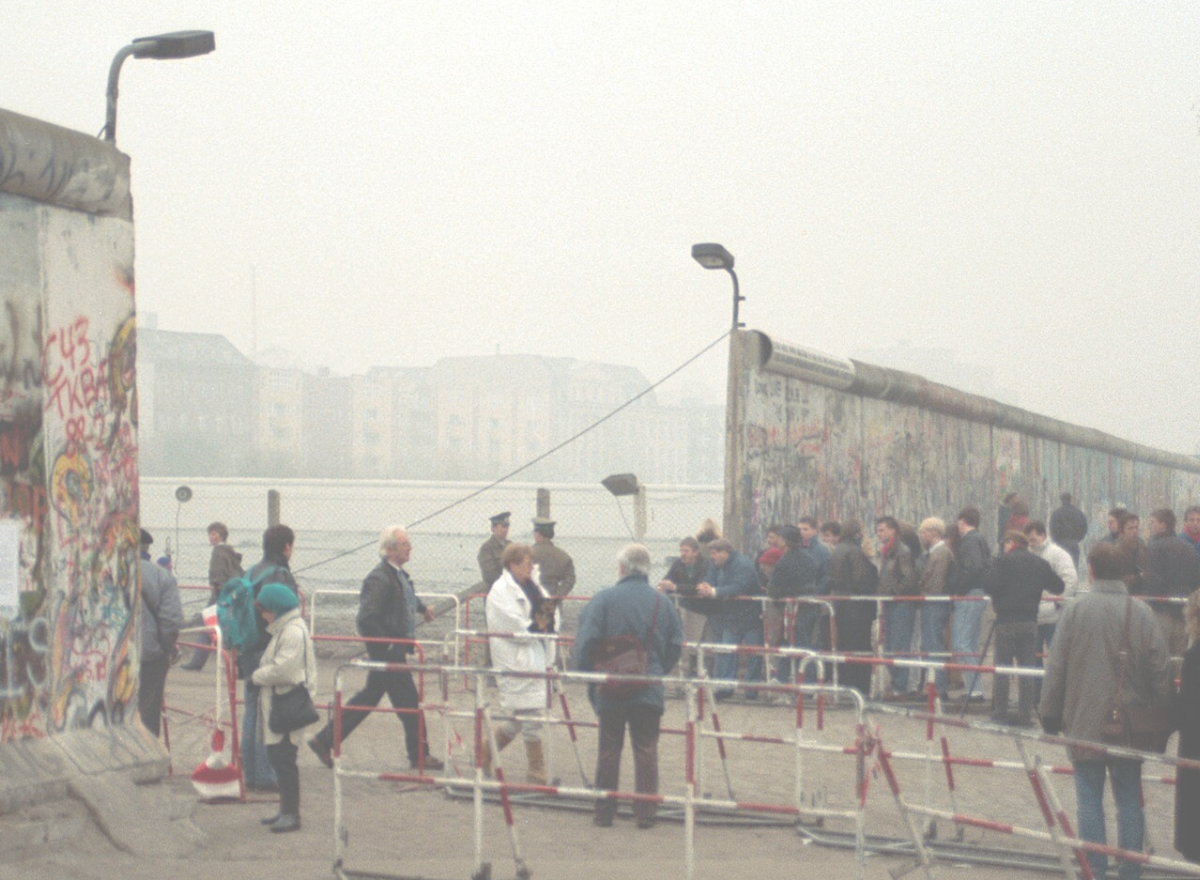
Post-War/Post-Wall: Journalism in Times of Polarization
Northern Arizona University Student Union
Language: English
Info
6.15 p.m. | Reception at Berlin Wall Exhibit, NAU Student Union
7 p.m. | Conversation in the Grand Canyon Room, NAU Student Union
Join 2025 Thomas Mann Fellow Susanne Beyer for a conversation on “Post-War/Post-Wall: Journalism in Times of Polarization” at Northern Arizona University, organized by the Martin-Springer Institute. The conversation will explore the challenges and responsibilities of journalism in societies marked by division and polarization. During her residency at the Thomas Mann House House, she explores the question of whether journalism needs to change in polarized times, whether there can be ways to report critically and empathetically at the same time, and whether journalism can initiate dialogues that bring people together rather than driving them apart. Beyer is a German author and journalist for the SPIEGEL.
Participants

Susanne Beyer studied German literature, history and journalism in Bamberg and Vienna. After her vocational training at Deutsche Journalistenschule (DJS), she initially worked as a culture editor at SPIEGEL, where she was deputy head of department. She was deputy editor-in-chief of SPIEGEL for four years, then worked as a journalist in SPIEGEL's Berlin office and now writes for the editorial team. Alongside her job, Susanne Beyer is currently training to become a mediator.
Partner
An event by the Martin-Springer-Institute at the Norther Arizona University, co-presented by the Thomas Mann House Los Angeles.
