


Thomas Mann House Events Archive
March 2026
Exhibition "Democracy Will Win!" at University of Nevada
University of Nevada

Information
Join the Department of World Languages and Cultures at University of Nevada for the traveling exhibition "Thomas Mann: Democracy Will Win!"
The exhibition commemorates the series of lecture tours that the Nobel Laureate conducted throughout the Unites States from the late 1930s to the mid-1940s. The first of these tours began at Northwestern University, where more than 4000 people came to hear him speak about the fundamental reasons for liberal democracy. “It is a terrible spectacle when the irrational becomes popular,” Mann said in a speech at the Library of Congress in 1943, and he drew on his considerable powers of thought and expression to counter the sources of this spectacle through his confident motto: “Democracy will win.”
The like-named exhibit is divided into two parts: the first charts the changes in Mann’s political views, while the second connects Mann’s lectures tours to current political situations in both Europe and the United States.
Partner
The traveling exhibition Thomas Mann: Democracy Will Win! is a collaboration between the Department of World Languages and Cultures at the University of Nevada, and the Thomas Mann House Los Angeles.
Oliver Polak & Friends: One Night Only
Belly Room at the The Comedy Store (8433 Sunset Blvd, West Hollywood, CA 90069)

Language: English ・ This event is open to the public.
Info
For this one-night-only event at the iconic Comedy Store, Polak will be joined by an international lineup of guest performers, including Sarah Silverman, Nikki Glaser, Robby Hoffmann, Amir K, and additional surprise guests. Together, they explore themes of migration, identity, memory, and contemporary politics through the distinct lens of stand-up comedy.
A multiple award winner, bestselling author, and host of his own Netflix series, Polak is widely regarded as one of Germany’s most original and provocative comedic voices. As Germany’s most prominent Jewish stand-up comedian, his work moves beyond conventional “cultural exchange,” confronting audiences instead with sharp wit, vulnerability, and what he himself describes as “emotional damage with punchlines.”
Find more information here!
Participants

Oliver Polak is a stand-up comedian and writer. Half-German, half-Russian and Jewish: he certainly has all the ingredients needed for a third world war.
Oliver Polak’s fellowship project at the Thomas Mann House is titled "Stand Up For Comedy Across Borders." He aims to develop a show for comedy clubs in Los Angeles. In this show, he intends to make himself the subject, share his story, and perform his narrative night after night. Through his stand-up, Oliver seeks to engage in meaningful dialogue with Americans and challenge prejudices—including his own. He aims to explore both the humorous similarities and differences between cultures. His observations, reflections, and dialogues, along with the ups and downs of his journey, will be recorded like a diary, forming an experiential account that can lead to deeper insights.
Partner
An event by The Comedy Store and the Thomas Mann House Los Angeles.

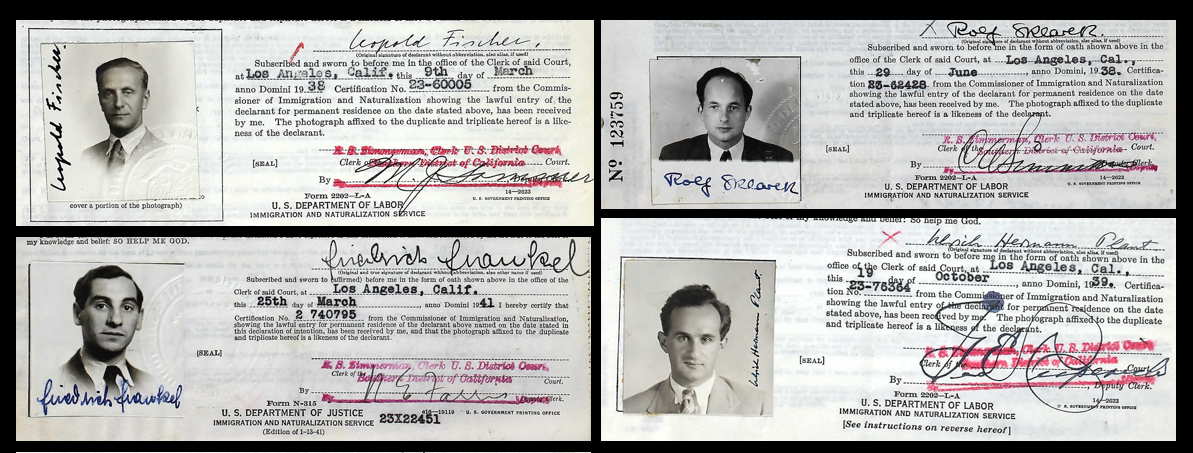
Émigré vs Exile Modernism and Architecture in L.A.
Thomas Mann House (1550 N San Remo Drive, CA 90272)
Language: English ・ By Invitation Only
Info
Join us in the living room of the Thomas Mann House for an insightful conversation between Volker M. Welter, an architectural historian specializing in modern architecture at UC Santa Barbara, and The New Yorker music critic Alex Ross, whose research explores German-speaking émigrés and exiles in California and their influence on music, literature, architecture, and the arts in Los Angeles.
When influential German Studies scholar Erhard Bahr remarked in his seminal book Weimar on the Pacific: German Exile Culture in Los Angeles and the Crisis of Modernism, that the architects Rudolph Schindler and Richard Neutra “were, strictly speaking, immigrants rather than exiles,” the historian established the year 1933 as a significant caesura separating “immigrant modernism” from “exile modernism” in California. Many German-speaking professionals already immigrated to California in the 1920s and earlier to pursue careers and progressive ideas of modernism before the Nazis even came into power. The exiles, such as Thomas Mann, Theodor Adorno, or Bertolt Brecht, who arrived in California as refugees after 1933, often had a much different and less enthusiastic understanding of modernism after their traumatic experience in Germany.
When architectural history ponders the works and influence of German-speaking, Central European architects in Southern California, a much simpler trajectory is often discussed: Schindler and Neutra brought modernist architecture to California when the two came to the U.S. Subsequently, other German-speaking architects working in architecture in the Los Angeles area are evaluated in comparison with the two “masters.“ In sharp contrast, the works of those exiled architects who fled to California after 1933 are rarely considered at all. Recent scholarship on these architects suggests that distinguishing, analogous to Bahr, between immigrant architects and exile architects allows an astonishingly differentiated picture of the impact of German-speaking architects on Southern California to emerge.
In their conversation, Welter and Ross will explore the nuances around different concepts of modernism in California before 1945, as these transatlantic currents and theoretical frameworks did not only leave their mark on architecture, but can also be seen, discussed, and exemplified in film, music, literature, and the visual arts.
Participants

