Info
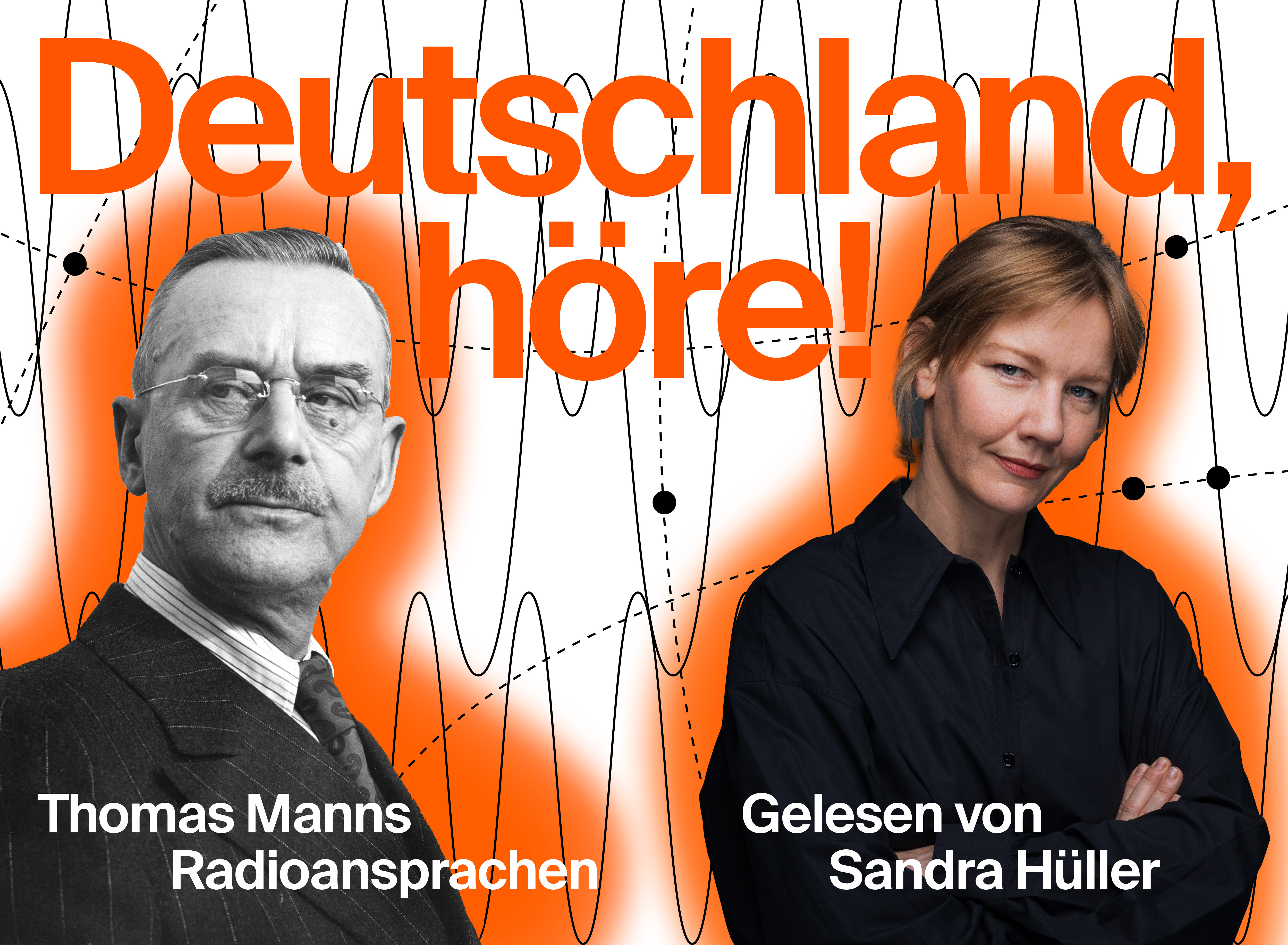
“Hell, Germans, came upon you.” Thomas Mann’s relentless and uncompromising message in his radio addresses broadcast by the BBC between 1940 and 1945 was a plea for humanism and democratic renewal—and at the same time a ultimately unsuccessful wake-up call to a country that had committed itself to delusion and total destruction.
To mark the 150th anniversary of Thomas Mann’s birth, the BBC radio addresses have been newly recorded by actress Sandra Hüller. Thirteen outstanding contemporary voices from politics, scholarship, and culture comment on them and enter into a dialogue with Mann’s texts.
*This radio program was produced in German*
Episodes

Introduction to Thomas Mann' Radio Addresses
“It is the voice of a friend. [...] The voice of a Germany that showed the world a different face and will show it again, rather than the hideous Medusa mask that Hitlerism has imposed on it. It is a warning voice.”

On Thomas Mann's Radio Address from October 1942
"It's not 1940. We're not in a world war, but the political tensions, the rise of fascism, the disillusionment with democracy that we see today, there are parallels, of course."

On Thomas Mann's Radio Address from December 24, 1940
"Thomas Mann relentlessly exposed all this hypocrisy and truly gave voice to the horror of National Socialism."

On Thomas Mann's Radio Address from February 1941
“I would have wished for somewhat greater rhetorical finesse, more verbal wit, more direct address, and less blunt denunciation—less relentless verbal assault on Hitler himself.”

On Thomas Mann's Radio Address from January 1942
“A regime that denies humanity would have cast people like me aside as once deemed unworthy of life.”

On Thomas Mann's Radio Address from March 1942
“From my perspective, democracy is seriously endangered today, including America.”

On Thomas Mann's Radio Address from April 1942
“As a child, or as a young person, it was clear to us that our city had been destroyed because those other cities had been destroyed by the Germans.”

On Thomas Mann's Radio Address from August 25, 1943
"He tried to shake up the Germans and wake them up and make them understand the situation the world and the country were in and that they had to change course."
To the Episode

On Thomas Mann's Radio Address from July 27, 1943
“Where language is lost, democracy and peace also die.”

On Thomas Mann's Radio Address from February 28, 1944
"It should actually say: The world is outraged, the world accuses you, the world does not understand you!"

On Thomas Mann's Radio Address from May 1, 1944
"I am not Thomas Mann, of course, nor is the United States in the throes of fascism. But the signs are all there."

On Thomas Mann's Radio Address from January 14, 1945
"It's not 1940. We're not in a world war, but the political tensions, the rise of fascism, the disillusionment with democracy that we see today, there are parallels, of course."
To the Episode

On Thomas Mann's Radio Address from May 10, 1945
"No country has as much responsibility as Germany to ensure the future of Jewish life."

On Thomas Mann's Radio Address from November 8, 1945
"In times like these, we can be glad that there was a Thomas Mann, who upheld the German spirit on behalf of many
against all the filth and dirt and drunkenness."
To the Episode
- October 1940 / Alice Hasters
- December 1940 / Christian Wulff
- February 1941 / Feridun Zaimoglu
- January 1942 / Raúl Krauthausen
- March 1942 / Arne Friedrich
- April 1942 / Annett Gröschner
- August 1943 / Nicola Leibinger-Kammüller
- June 1943 / Düzen Tekkal
- February 1944 / Jutta Allmendinger
- May 1944 / Susan Neiman
- January 1945 / Michel Friedman
- May 1945 / Charlotte Knobloch
- November 1945 / Navid Kermani
A new edition of the radio addresses has been published by S. Fischer Verlag under the title Deutsche Hörer!, featuring a foreword and an afterword by Mely Kiyak.
A project in collaboration with Sonja Valentin and Hans Dieter Heimendahl.
Partner
In cooperation with DLF und the S. Fischer Verlag.

Villa Aurora & Thomas Mann House e. V. is funded by the Federal Foreign Office and the Federal Government Commissioner for Culture and the Media.